


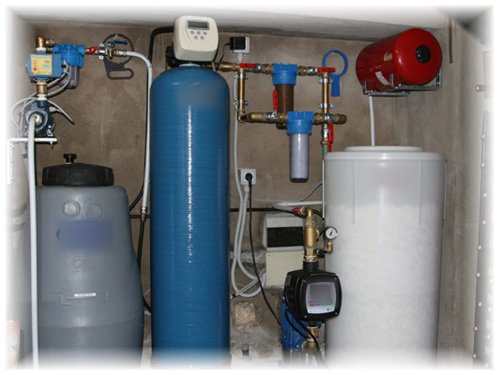
 DPR 59/09: Water treatment required.
Rev. 4 April 2016 – (Reading time: 8 minutes)
Is it mandatory to install an anti-limescale system where hardness is over 25°F?
ANSWER: Yes – BUT WHERE DOES

Treatment is mandatory for newly built and under renovation plants.
An example is when you change the boiler with a new condensation.
And Kalko Tronic, as a physical system, can you use it?
THE ANSWER IS YES, but only on the health part.
Below are some guidelines for standard with the use of KALKO TRONIC
Further comment on the use of Kalko Tronic in reference to the law

Existing installations:Apartment or single apartment
No problem with using Kalko Tronic.
New single boiler plants:within 100KW (typically real estate units).
For housing you can use a dispenserpolyphosphateunder boiler for the first plant load and install Kalko Tronic in the typical position of the softener.
After the first start of the heating system the customer may not remember to recharge the dispenser (common situation after 1-2 months of use): Kalko Tronic will protect the sanitary system, however in case of extraordinary work on the heating circuit (primary) it is advisable to always recharge thepolyphosphateto insert treated water.
New thermal power plants
Within 100KW of plant power only onepolyphosphatefor boiler load.
Above 100KW the law indicates the obligation to soften the water for the food load of the primary plant, in fact there is always a small softener (e.g. 7-9 liters resin) on the central load: sanitary water can be treated with Kalko Tronic, in compliance with laws 31/2001 and 25/2012.
Installations undergoing renovation of buildings (apartments)
Single boiler: the insertion of a dispenser should be provided under the boilerpolyphosphates.
Thermal power plant: a softener must be provided on the load of thermal power stations as indicated at the previous point.
Kalko Tronic can instead be used for sanitary water (dpr 31/2001).
Over 350KW: See standard 8065
It is important to read the legislation: treatment is not mandatory on the health side but if used as the only treatment could be in contrast to drinking water laws, let’s try to understand better below.
The DPR 59/09 requires water treatment if you exceed the 15° French, however if we had water at the origin of more than 55/65° French the quantity of sodium to reach 15°Fcould be higher than that allowed by Legislative Decree 31/2001 and reiterated by the latest DM 25/2012: WATER CONSIDERED NOT POTABILE.
TheArticle 4means: "aparagraph 14 is provided with very precise requirements regarding the treatment of intended waterat the power supply of heating systems.”
Kalko Tronicleaves the treatment of technical water to those of duty (using polyphosphates or softeners) andIt seeks to safeguard the drinking line, where water passes in a certain quantity, reducing the costs of the individual user or the entire building.
To comply with the legislationthe simplest solutionfor single boileris to install a dispenser topolyphosphates.
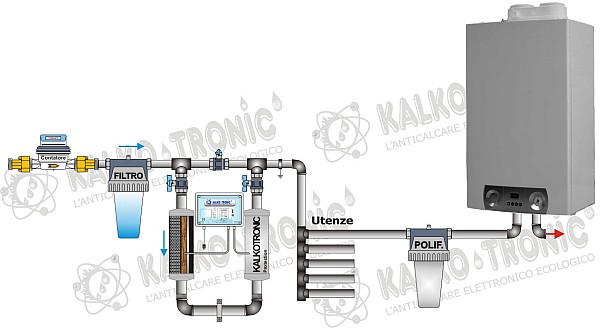
RECOMMENDING THE POLYPHOSPHATE: Everyone’s Problem
However the customeryou often forget to reload it(one of the major causes of boiler exchanger problems): the function ofKalko Tronic becomes decisivefor the protection of the exchanger and pipes.
In case of work on the thermal system (replacement of a radiator or other interventions), it is important to recharge in order to be able to insert into the water heating system treated chemically and preserve it over time.
The solution in the thermal power stations of condominiums(where there is a central thermal power station)is long known: is installed a small softener a few liters resin in central heating (e.g. 7-9 liters resin with very low consumption).
It is a softener smaller than the one installed at the condominium level for drinking users: for 40 apartments, for example, they serve dimensions such as 200/250 liters resin, whose water consumption for rinses is 2000/2500 liters and 30-35 kg of saltfor each regeneration.
Costscan easily climb4-6000 euro per year(control manual and loading salt included).
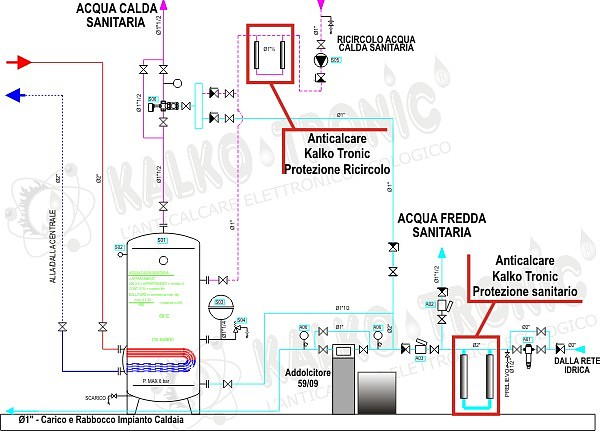
Kalko Tronic is recommended for drinking water use.
Further study on the law
Some points that we consider important in Law 59/09.
Regulation implementing Article 4, paragraph 1, letter a) and b), of the Legislative Decree 19 August 2005,
No 192 on the implementation of Directive 2002/91/EC on the energy performance of buildings
(For the full text of the D.P.R. link to the website:http://energyefficiency. acs.enea.it/doc/dpr_59-09.pdf)
With the D.P.R. n° 59/09 Italy responds to the call of the European Community for adjustments in this matterenergy efficiency required by Directives 2002/91/EC (Energy efficiency in buildings) and2006/32/EC (Energy end-use efficiency and energy services).
The decree defines the methodologies, criteria and minimum requirements that buildings and plants must possess
for:
– winter air conditioning (see Legislative Decree 192/05)
– preparation of hot water for sanitary purposes
– summer air conditioning (main news compared to Legislative Decree 192/05)
Of particular interest is Article 4 paragraph 14 which defines the limits of hardness of water and power of thewater treatment plants. In particular, it is established that:

For the specifications on the types of processing and the methods of execution, the Decree refers to the normUNI-CTI 8065.
Below is a brief extract of the salient articles that make up the ministerial decree.
Article 1
The scope is that of Legislative Decree No 192 of 19/08/2005 and is related to:
- new buildings
- buildings undergoing renovation involving the installation of new thermal installations (or parts of installations)
in existing buildings or renovations of the same plants or replacement of heat generators.
The general criteria, calculation methodologies and minimum requirements for the performance of
thermal systems for both air conditioning and the production of hot water for sanitary purposes for
new buildings or renovations.
Article 4
In paragraph 14 are provided very precise requirements regarding the treatment of water
intendedat the power supply of heating systems.
For plants with a total power of less than 350 kW not intended for the production of hot water
sanitary and water with a hardness exceeding 25 °F, or for the production of hot water
Health care but with a hardness greater than 15 °F, the following requirements shall be met or given:
- chemical conditioning treatment for plants with a nominal fire power of less than 100 kW
- softening treatment for plants with a rated total fire power of 100 to 350 kW
Please refer to the Note UNI CTI 8065 for the methods of processing.
With regard to plants with a power capacity exceeding 350 kW, the information provided shall remain valid
Article 5(6) of DPR 412/93.
Article 5
It is established that the general criteria and requirements for operation, maintenance and inspection of installations
Thermal for winter air conditioning continue to follow the indications provided by Legislative Decree 192/05.
In particular, the entities responsible for the control and maintenance of the plants are the owner, the
holder, the administrator or a third party for them and that the list of requirements to be met are listed
in Annex L of Legislative Decree 1905 and subsequent amendments.
Some points that we consider important of the standard UNI 8065
1.1 Subject matter
This standard covers:
the definition and determination of the chemical and chemical-physical characteristics of water used in civil thermal installations.
More specifically, the characteristics of food water and reintegration of the circuit in relation to the following types of technical installations are examined:;
hot water heating systems;
low pressure steam boilers used for heating (direct or by heat exchangers) with high condensation recovery;
circuits with water at a temperature greater than the boiling temperature at atmospheric pressure (superheated water) up to a maximum temperature of 180 °C;
sanitary hot water production plants;
a description of the water treatment systems; an explanation of the control arrangements and their frequencies.
Note — This standard does not cover water treatment for pressure steam generators greater than bars and for superheated water cycles operating at temperatures greater than 180 °C under UNI 7550.
1.3 Warnings
1.3.1 As far as hot water is concerned, however, no type of treatment can be envisaged which could prevent its possible use in food, with regard to the toxicological and microbiological parameters provided for in the current legislation, which is always considered in this standard.
1.3.2 This standard also considers that water intended for the supply of heat plants for civil use has characteristics similar to that of drinking water prior to treatment.
5.2 Choice of treatments
The choice of type of treatment should be made according to the characteristics of the water to be treated, the type of implantation and the required purity limits.
The various types of treatment (physical, chemical-physical, chemical) are used, as necessary, individually or in combination with each other. The client’s task is to define the characteristics of the type of thermal system that he intends to adopt while the supplier’s task is to propose the treatment of suitable water so that the client can choose the equipment that suits him technically and economically (initial and operating cost) as well as in terms of ease of operation.
These tasks may be entrusted to competent third parties who may perform an advisory role and whose position must be defined in advance between the parties.
6.4 Sanitary hot water production plants(n.a.: Primary circuit power)
6.4.1 Treatments prescribed
In general it is necessary to install a safety filter to protect the systems. Subsequently, depending on the characteristics of the water, a softener and/or an automatic proportional dosing system of chemical conditioning agents (anticorrosive and/or food hardness stabilisers) may be installed.
6.4.2 Points of intervention
Both treatment plants and conditioning points must be upstream of hot water producers.
6.4.3 Characteristics of food water
I'm looking clear.
Hardness:
up to 25° fr of temporary hardness both softening and chemical conditioning of hardness stabilization and/or anti-corrosive may be used.
More than the 25th fr of temporary hardness, softening is mandatory.
If necessary, the softening will be complemented by anti-corrosive and/or anti-inflammant chemical conditioning.
Some interesting information
"Poliphosphates": what are they?
They are inorganic compounds resulting from the polymerisation of sodium metaphosphate NaPO3. They are added to detergents to improve the action of soap and to obtain a more abundant foam: Polymer chain polyphosphates of between 2 and 25 atoms are mainly used for this purpose.
Those inside the boiler dispensers bind to the Ca++ and Mg++ ions, responsible for water hardness, forming complex molecules: In this way the formation of incrustations is avoided and, above all, it is avoided that these cations bind to anionic surfactants and thus decrease their concentration;
They also strengthen the detergent action of the surfactants (they are present in a 1-2% condensation in detergents): In fact, polyphosphates are absorbed by polar fibres and dirt, causing the dispersion of dirt particles by electrostatic repulsion effects.
Contraindication to the use of polyphosphates is the increased concentration of these substances in water: In fact, they act as fertilizers of aquatic plants and algae that, developing, impoverish oxygen water, thus damaging the biological balance of aquatic life.
Our advice is the moderate use of these products, where they actually serve, then letting the Kalko Tronic systems work actively for the protection of sanitary installations (changer, pipes, coils), this to preserve nature from chemical pollution.
Interesting links:


